
Dozens of Indian-flagged ships and over a thousand seafarers are stranded in the Persian Gulf, Gulf of Oman, and surrounding areas due to the closure of the Strait of Hormuz amidst ongoing military actions involving the US, Israel, and Iran.

A Thai cargo vessel was struck by missiles near the Strait of Hormuz, leaving three crew members missing and prompting a rescue operation by the Royal Navy of Oman.

Addressing the 36th extraordinary session of the Council of the International Maritime Organisation (IMO) held on Thursday in London, the Indian envoy said, "India remains deeply concerned about the evolving situation and continues to call for de-escalation through dialogue and diplomacy, with utmost restraint and priority being given to the safety of civilians."

Amidst rising Middle East tensions, External Affairs Minister S Jaishankar highlights India's strategic dialogue with Iran to safeguard maritime traffic through the Strait of Hormuz, ensuring India's energy security and continued oil trade.

24 Indian-flagged vessels with 677 Indian seafarers were currently located west of the Strait of Hormuz, and four vessels with 101 Indian seafarers were stationed east of the strategic waterway.

The report said ships must submit full documentation, obtain clearance codes and accept IRGC-escorted passage through a designated corridor.

The container ship SELEN, en route to Karachi, was denied passage by the Islamic Revolutionary Guard Corps (IRGC) Navy due to lack of permission and failure to coordinate with Iranian maritime authorities.

Prime Minister Narendra Modi spoke with Iranian President Masoud Pezeshkian, condemning attacks on critical infrastructure in West Asia and emphasising the importance of safeguarding freedom of navigation and ensuring secure shipping lanes.

India has condemned the escalating attacks on commercial shipping in West Asia, particularly after a Thai-flagged vessel en route to India's Kandla Port was targeted in the Strait of Hormuz. The attacks have disrupted global oil and gas supplies, impacting India's energy imports.

IRGC said vessels seeking to sail through the strategically critical Strait of Hormuz must obtain Iran's approval; otherwise, they could become targets of Iranian attacks.
Two Indian ships carrying liquified petroleum gas (LPG) from the Gulf countries crossed the Strait of Hormuz early on Saturday morning, raising the number of Indian vessels safely passing through the war-hit, narrow shipping lane to three.
Fathali further stated that Tehran has instructed its embassy in India to facilitate the Indian government, ensuring smooth operations amid the ongoing regional conflict.
Trump said that the strait will be "open very soon" if ongoing negotiations with Tehran continue successfully.

An Indian-flagged crude tanker safely departed from the UAE's Fujairah after loading oil, despite an attack on the oil terminal. The Indian government is closely monitoring the situation in West Asia to ensure stable fuel supplies and maritime safety.

An Indian-flagged crude oil tanker, Jag Laadki, safely sailed from the UAE's Fujairah port despite an attack on the terminal and is scheduled to reach India. The Indian government is working to ensure the safe passage of remaining Indian-flagged vessels in the region.

Prime Minister Narendra Modi will chair a meeting with senior ministers to review the petroleum, power, and fertiliser sectors in light of the evolving situation in West Asia, focusing on ensuring uninterrupted supply and stable logistics.

'After we were alerted about the war, none of us could sleep for the next two nights while sailing through those waters.'

Indian rice exporters are seeking urgent government support to mitigate the impact of shipping disruptions caused by the Iran crisis and instability in key maritime routes. The disruptions have led to increased freight rates, insurance premiums, and fuel costs, impacting domestic prices and exporter profitability.

An oil tanker carrying Saudi crude safely reached Mumbai after crossing the war-hit Strait of Hormuz with its tracking system briefly switched off.
Prime Minister Narendra Modi will chair a meeting with senior ministers to assess the petroleum, power, and fertiliser sectors in light of the ongoing situation in West Asia, focusing on ensuring uninterrupted supply and stable logistics.
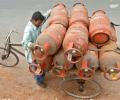
Argentina has significantly increased its LPG exports to India to help mitigate shortages caused by the ongoing conflict in West Asia. This partnership is becoming increasingly important for India's energy security.

Prime Minister Narendra Modi convened a meeting with senior ministers to assess the impact of the evolving situation in West Asia on India's crude oil, gas, petroleum, power, and fertiliser sectors, focusing on ensuring uninterrupted supply and stable logistics.
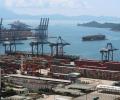
With the Iran war escalating sharply and crisis deepening in the global energy market, India on Monday unveiled a coordinated plan to support exporters and shippers caught in the fallout.

Iran's Islamic Revolutionary Guard Corps (IRGC) claims control of the Strait of Hormuz and reports striking a US destroyer, escalating tensions in the Middle East following retaliatory strikes between Iran, the US, and Israel.

According to the Pentagon, the vessels were targeted as part of efforts to prevent the deployment of naval mines in the strategically vital passage through which a significant portion of global crude oil shipments transits.

Aseem Mahajan, Additional Secretary (Gulf) in the Ministry of External Affairs, on Saturday informed that five Indians have been killed and one is missing due to the ongoing conflict in West Asia. He added that Indian missions remain open round the clock and are constantly working to provide assistance.
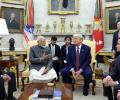
Prime Minister Narendra Modi and US President Donald Trump discussed the Middle East crisis, with a focus on the Strait of Hormuz.

The vessels are carrying around 92,600 metric tonnes of LPG and have 33 and 27 Indian seafarers onboard, respectively. Visuals showed Pine Gas crossing the critical chokepoint.

Will rising tensions between US-Israel and Iran threaten crude oil supply through the Strait of Hormuz, putting India's fuel prices, imports, and economic stability at risk?

External Affairs Minister S Jaishankar has engaged in multiple conversations with his Iranian counterpart to secure safe passage for Indian merchant vessels through the Strait of Hormuz amidst escalating tensions in West Asia.

According to the report, the Pentagon is deploying the USS Tripoli ARG, along with the 31st Marine Expeditionary Unit (MEU), part of its own strike group.

Two more Indian-flagged LPG tankers have begun their journey from the Persian Gulf, navigating the Strait of Hormuz amidst regional conflict, following disruptions caused by recent tensions in the Middle East.

A senior government official confirms that Indian vessels do not require permission to navigate the Strait of Hormuz, despite regional tensions. Several Indian ships, including LPG tankers, have safely crossed the strait, ensuring continued supply of essential commodities to India.

If the oil infrastructure is attacked by the United States, the whole area could be flooded with oil, spilling into the Persian Gulf.
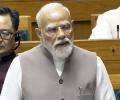
Prime Minister Narendra Modi addressed Parliament on the West Asia crisis, advocating for dialogue and diplomacy, ensuring the safety of Indians in the region, and addressing concerns about fuel and food security.

A French soldier was killed while several others were injured in an attack in the Erbil region of Iraq, French President Emmanuel Macron confirmed. Macron, in a post on X, confirmed that Chief Warrant Officer Arnaud Frion of the 7th Battalion of Chasseurs Alpins lost his life in the attack.

Indian refiners are negotiating for additional crude cargoes from the US, Russia, and West Africa to ensure adequate supplies amid Middle East tensions. Refineries are maintaining normal processing rates and deferring maintenance to build reserves. The move comes as conflict impacts tanker movements through the Strait of Hormuz, a key energy transit route.
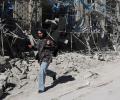
India has relocated the majority of its students from Tehran due to the escalating conflict in West Asia. The Indian embassy has arranged for their transportation, food, and accommodation outside of Tehran. An advisory remains in place for other Indian nationals in Iran to stay indoors and exercise caution.
Hundreds of Indian seafarers are stranded on vessels carrying crude oil, LPG, and LNG in the Persian Gulf due to the ongoing conflict in the Middle East, causing disruptions to India's energy supplies.
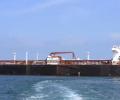
Despite ongoing tensions in West Asia, the successful arrival of the LPG carrier 'Nanda Devi' in Gujarat ensures a steady supply of liquefied petroleum gas to India, highlighting the country's efforts to secure its energy needs.
 © 2026 Rediff.com - Advertise with us - Disclaimer - Privacy Policy - Sitemap - Feedback - About us - Terms of use - Grievances